
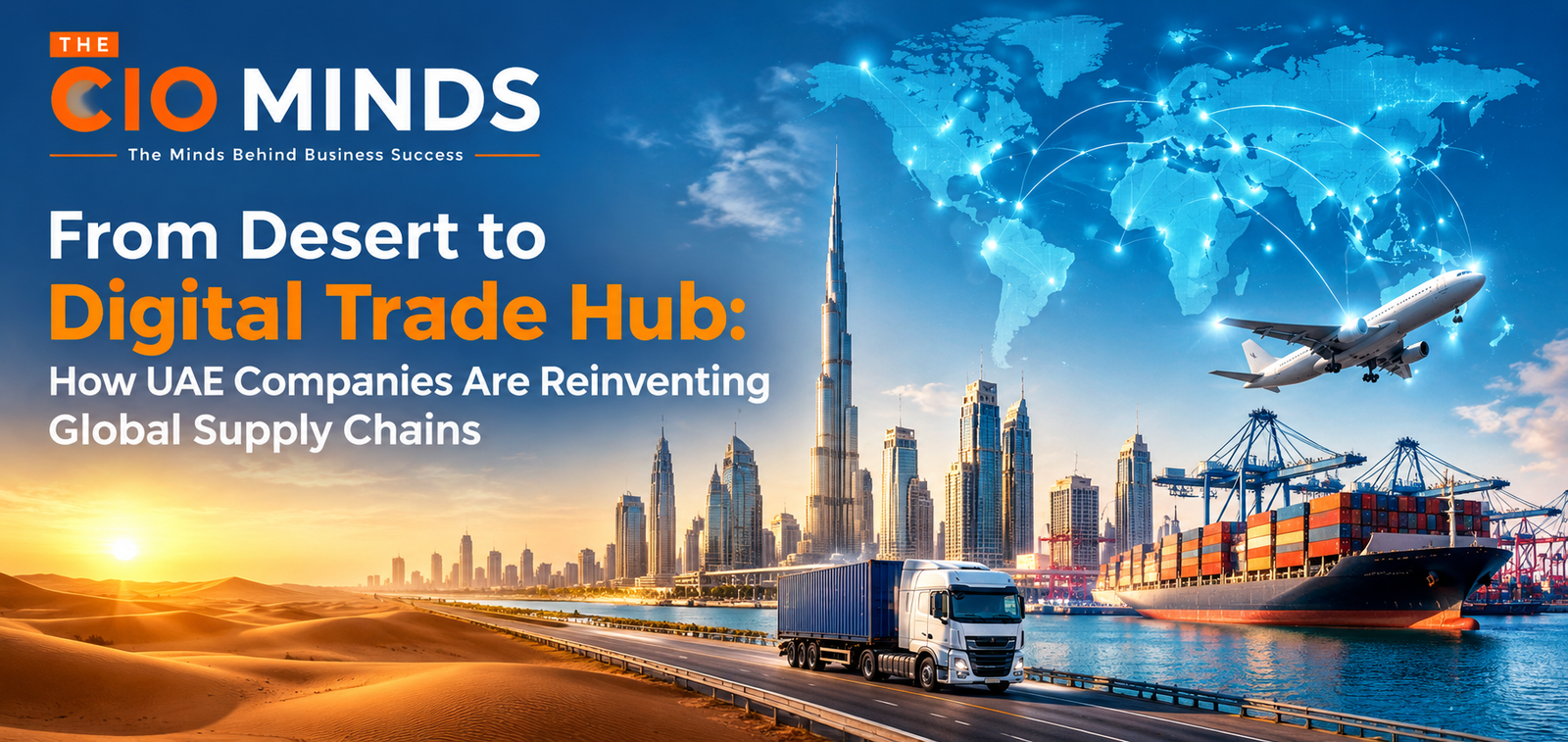
Jebel Ali opened in 1979, a man-made port on a coastline that had almost nothing around it. The bet was simple and a little reckless: build it and the ships will come. They came. Decades later, that port and the airports, free zones and rail links that grew around it have put the country at the centre of how UAE global supply chains work, and increasingly how information about cargo travels as well.
I want to look at what changed, who is doing the changing, and why global entrepreneurs are choosing the UAE to start and expand their businesses. Some of it is obvious. Some of it isn’t.
Geography helps, but it isn’t the story
Yes, the country sits between Europe, Asia and Africa. Yes, billions of people live within a few hours’ flight. Any map will tell you that. But Panama has a good location too, and so does Egypt, and neither became what the UAE trade hub is today.
What set the Emirates apart was building capacity before anyone asked for it. Berths sat half-empty at first. Terminals were sized for traffic that hadn’t turned up. A lot of planners elsewhere would have called that wasteful. Here it meant that when shippers wanted somewhere dependable to route goods, the room was already there.
The hardware: ports, runways, free zones
Talk to any freight forwarder and the same names come up: Jebel Ali, Khalifa Port, Dubai South, the industrial zones around Abu Dhabi. Together they carry the UAE logistics industry, which moves everything from auto parts to vaccines to cut flowers, often on the same day.
Free zones get less credit than they deserve. A company can hold full ownership, park stock beside the dock or the runway, and clear goods with far less paperwork. Picture a small firm importing electronics for resale in East Africa. In a free zone, that business can run with three staff and a rented warehouse. Elsewhere it might need ten and a customs broker on retainer. This is a big reason UAE global supply chains pass through the country even when the buyer and seller are both somewhere else entirely.
The software layer
Concrete and steel only go so far. The newer gains are in information, and they’re less visible.
Digital trade in the UAE now covers electronic customs declarations, paperless shipping documents and shared platforms that connect ports, carriers and trucking companies. Blockchain pilots for trade paperwork and digital trade finance sit alongside them, though how far those will scale is still an open question. Honestly, nobody knows yet which of the pilots will stick.
The reason all this matters is dull but real. A container that sits idle for two days costs money. A container nobody can locate costs more. When a shipper can see where cargo is, when it clears and what is owed, they can plan. Small businesses gain the most, because they can’t afford a department of customs specialists.
Small fixes that add up
Warehouse automation is spreading around Dubai and Abu Dhabi, with robotic picking and storage trimming errors and shaving hours off order times. Drone deliveries are being trialled for medical items and short-hop parcels. Cold-chain monitoring for food and medicine keeps improving. Forecasting tools try to predict demand and spot disruption early.
None of this is glamorous. Most UAE supply chain innovation is about removing a little friction in a thousand places, rather than one giant leap. A few minutes saved per pallet becomes serious money across a year of shipments.
Why founders land here
Ask a handful of entrepreneurs and the answers differ, but patterns show up.
Setting up is quicker than in many markets. Foreign ownership rules have relaxed, licences can often be issued fast, and long-term residency means a founder can plan beyond the next renewal. No personal income tax doesn’t hurt either when every dirham is going back into the business.
Hiring is easier than people expect. The population is drawn from nearly every country, so finding an Arabic-speaking compliance officer, a Russian-speaking sales lead and a developer who trained in Bangalore doesn’t take three separate recruitment drives. Banks, lawyers and insurers are used to international clients, and English works nearly everywhere in business.
Then there’s reach. Someone selling household goods to customers in Central Asia can hold stock in a free zone, run the shop online and deliver within days. Ten years ago that needed an established company with branches in several countries. Today a team of five can manage it, which explains why UAE global supply chains keep attracting new entrants.
Who’s actually doing it
The regional e-commerce businesses are now using fulfillment services in a number of countries out of just a few warehouse bases located in the UAE. The old-school commodity traders, who did business over the telephone, are now facing dashboard displays. The port operators located in this place manage terminals that are thousands of kilometres apart.
Even the smaller businesses adopt this model. A spice importing firm in Sharjah, a parts distribution company in Ajman, and a clothing re-exporter in Dubai have nothing in common but all use the same infrastructure for their work.
Whatever their size, they are all customers of the same UAE trade hub, whether they think of it that way or not.
Where it pinches
Costs rise quickly. Office space, housing and experienced staff can all get expensive, and anyone entering a crowded niche like general freight forwarding will find thin margins and a lot of rivals. Rules keep changing too, especially around customs classification, sanctions checks and data handling, so compliance can’t be an afterthought.
And the whole model leans on the outside world. If shipping lanes get disrupted or global demand softens, a country built around flows of goods feels it early. The UAE logistics industry has coped well with past shocks, but resilience takes upkeep.
Advice for anyone considering it
Choose a free zone based on what you ship and who you sell to, not on whichever licence is cheapest. Speak with people already operating there before signing anything. Make local contacts, because introductions still carry weight here. And put money into digital tools early. Companies that bolt on technology later tend to lose ground to those that started with it, and strong UAE supply chain innovation rewards the ones paying attention.
One more thing. The setup cost is the smallest part of the picture. The real payoff comes from the network, and it builds the longer you stay.
The short version
Decades ago, someone bet on a port in the middle of nothing. That bet turned into runways, free zones and a business culture comfortable with outsiders. Now the focus is shifting to data, automation and better coordination, and digital trade in the UAE is likely to deepen that advantage rather than replace it.
That’s really why global entrepreneurs are choosing the UAE to start and expand their businesses. The infrastructure is there, the rules are workable, and the country keeps building ahead of what comes next. For someone with a product and a plan, the road from desert to digital hub is already paved. You just have to decide when to start driving.
FAQ
1. Why is the UAE becoming a global digital trade hub?
The UAE connects major markets across Asia, Europe, Africa, and the Middle East. Its ports, airports, logistics infrastructure, free zones, and digital trade initiatives enable businesses to move goods and manage cross-border transactions more efficiently. The country’s focus on technology and integrated logistics is further strengthening its role in global supply chains.
2. How are UAE companies transforming traditional supply chains?
UAE companies are moving from traditional, paperwork-heavy processes toward integrated digital systems. These systems connect suppliers, manufacturers, shipping companies, customs authorities, warehouses, and customers, improving shipment visibility, coordination, and decision-making.
3. What role does artificial intelligence (AI) play in UAE supply chains?
AI helps businesses forecast demand, optimize inventory, predict potential delays, identify supply chain risks, and improve logistics planning. UAE authorities are also adopting AI to strengthen customs operations and support more proactive trade management.
4. How is digitalization improving international shipping and logistics?
Digitalization allows businesses to track shipments, exchange documents electronically, automate customs processes, and coordinate deliveries across transport networks. These improvements can reduce manual errors, administrative work, and avoidable delays while increasing supply chain transparency.
5. What are the benefits of the UAE’s strategic geographic location?
The UAE’s position between major global markets makes it an important gateway for international trade. Companies can use its logistics networks to connect suppliers and customers across multiple regions, coordinate multimodal transportation, and develop alternative trade routes when disruptions affect conventional shipping lanes.
6. How are UAE free zones supporting global supply chain transformation?
UAE free zones offer businesses infrastructure and commercial environments designed to support international trade, logistics, manufacturing, and distribution. They can help companies establish regional distribution centres, manage inventory closer to customers, and expand into new markets. Digital trade ecosystems are also helping businesses connect commerce, customs, and fulfilment services.
7. What is the role of blockchain in digital trade?
Blockchain can create secure, tamper-resistant records of transactions and shipment documentation. When integrated with customs and logistics platforms, it can improve traceability, data integrity, and trust among trading partners.
For example, Abu Dhabi Customs’ TradeChain platform is designed to integrate with blockchain-based trade platforms, supporting more efficient and transparent customs processes.
8. How are UAE companies using real-time shipment tracking?
Businesses and logistics providers use digital tracking systems, connected devices, and satellite-based technologies to monitor cargo movements. These tools provide greater visibility into shipment locations and potential disruptions, allowing companies to respond more quickly to unexpected delays.
Dubai Customs’ Shahin system, for example, uses satellite-based tracking and electronic smart seals to monitor trucks and strengthen cargo security.
9. How is e-commerce changing UAE supply chains?
The growth of e-commerce is increasing demand for faster fulfilment, efficient warehousing, cross-border delivery, and accurate inventory management. UAE companies are responding by integrating online marketplaces with logistics providers, customs services, and fulfilment networks.
These capabilities help businesses, including small and medium-sized enterprises (SMEs), reach international customers without having to build every part of their own distribution infrastructure
10. How are UAE companies improving supply chain resilience?
Companies are diversifying suppliers, exploring alternative transportation routes, improving inventory visibility, and using data analytics to identify potential disruptions.
National initiatives also emphasize alternative sourcing, local production, and international partnerships to improve access to essential food, medical, and industrial goods.